Showing posts with label hubby. Show all posts

Friday, July 6, 2012

Hot Beirut; in so many ways

English

This, here, is the first of a series of posts on GeekFest Beirut 5.0: I had a good time, there are many things I would love to share with you guys, but I do not want this one blog post to turn into a phonebook-size novel. So I will introduce my two-cents on the event in several reviews hoping it will make it easier on your eye. I know you appreciate the thought (which was actually a request/order from my sister. ahem).

Yesterday I attended my very first GeekFest.

The hot temperature and extreme humidity did not deter me. I bravely dumped my kids on my mom (Parenting 101) and ran as fast as I could (Mommy Survival Manual Lesson 149) towards Gemmayze, before grand-ma started pulling her hair and pulling me back home in the process.

I am not what you would call a geek although I do spend a lot of time using technology (does that count? I mean babies are born with that skill now, so that cannot be the only criteria) but I have a few friends in the Geek community and I was looking forward to seeing them in the flesh. Facebook and Twitter are fun enough but it is always reassuring to know your tweeps are not some computer-generated modern Imaginary Friends.

So we all gathered in The Alleyway in Gemmayze, on the über-popular Gouraud Street (I still cannot believe it has a page on Wikipedia) with our unintentionally sophisticated frizzed up hair flowing in Beirut's tragic wet breeze. The summer has started and over here, it equals excessively high temperatures and toxic humidity. Granted, we all looked like we had just been groomed by Cyndi Lauper's stylist but it was a happy crowd nonetheless that mingled and snapped photos and twitted and facebooked and... Danced. Apparently, geeks dance too.

Do not get me wrong, I love my geeks. I grew up with one and I am married to one. Not the same one (for those of you out there, keen on getting into specifics). But honestly, I was surprised by the look of this event and the attitude of everyone there: geeks are actually pretty cool! They are not your usual nerdy stereotyped losers Hollywood loves to mock so much.

Geek is truly the new cool (thank you Steve Jobs, I guess).

As GeekFest would say: "Le Geek C'est Chic"

And because I do not just babble, I present you the indisputable evidence that geeks do rock indeed, on video!


And this is when I realized one of my favorite online people is also the bravest geek ever. Lynn, you rocked that red carpet!

It was also a pleasure finally meeting face to face one of the most active young women on the blogosphere and the founder of One Wig Stand, the stunning Loryne who gave a presentation on Bras For A Cause and brought t-shirts and bras with her so we could grab one of the last limited edition pieces that are now off the market.

But I will leave my "talk on the talks" for another post.

Right now I will just leave you free to loop that video over and over again, because geeks are as addictive as the internet and it is so much fun to watch them nerd that red carpet! Yes, I did just use the word "nerd" as a verb and synonym of "rock". After what I experienced last night, I believe it is well-deserved.

Oh, and no internet all over Lebanon on GeekFest day. A coincidence? I think not.

To the conspirators who tried to ruin GeekFest by annihilating the internet yesterday, just know that you may "break" the connection but you cannot break a geek's spirit! Your evil plan will not ever discourage them. If anything, you only gave them more reason to come up with new ways to drive you crazy! And to those of you out there who think I am just another conspiracy theory freak, I have one word for you: "hack". If you remember, many Lebanese government sites were recently hacked by Anonymous Lebanon... Aha! Busted! ;)


Bookmarks:


Find this blog on Facebook

Tuesday, July 3, 2012

Maz Jobrani: Laughs for a cause

English

When I got online to buy my ticket for Maz Jobrani's latest show in Beirut about a month ago, little did I know I was making my first step towards meeting inspiring new friends. 

SANAD brings Maz Jobrani back to Beirut - Banner in Hamra Street
Photo: R. Abouzeid


I remember a time when it was possible, if we tried and searched really hard, to find a magic pathway hidden where the rainbow touches the earth. It feels like yesterday and an eternity ago. 

"Real" life, responsibilities, practicality and the disillusioned wisdom that comes with understanding rainbows are only optical phenomena ridden from any magic whatsoever is partly how we get to adulthood. And the older we get, the more likely we are to be forced to face notions and realities that we did not comprehend or even acknowledge for what they truly are and mean when we were younger. Death must be the most painful lesson of all. It sneaks in from behind and startles us in malicious ways. None of these ways are ever easy, and no time, knowledge and even faith can prepare us to the magnitude and actual suffering that comes with burying a loved one. 

Caring for sick relatives or friends has got to be the most difficult of responsibilities. The guilt that comes with their passing is all the more overwhelming as nothing we do ever seems enough or right. 

For my father, last year meant saying goodbye to his mother and again, only forty days later to his father. But before that painful involuntary closure, our family had been struggling with duty, guilt, judgemental relatives and neighbors, and even people we do not know, all having an opinion about what we should do and how we should do it. All of them ready to preach, none of them available to help. In the meantime, my father had two of the people he loves the most, condemned to living in their beds and unable to understand what is happening around them. Aside from suffering from advanced Alzheimer, their health was gradually worsening until medical assistance and institutionalized hospice care became a necessity.

So I admit the very first thought that came to mind when I stumbled upon SANAD on Facebook was "Oh my God, I so wish I had heard about this organization before". Which is why I feel it is my duty to introduce them to you and everyone else, as unfortunately, no one is exempt from disease or death.

The Arabic word SANAD (سند) literally translates to "Support". It is also the name of that wonderful non-governmental organization based in Hamra, at the heart of the Lebanese capital where the NGO recently invited Maz Jobrani in an effort to raise funds and awareness for their cause.


Virgin Ticketing Box Office was as easy as 1, 2, 3

The show was outstanding and Maz was hilarious, as always. It was also a pleasure watching local talents Joseph Azoury and Elias Ghoussoub's opening acts which were exceptional. I laughed so hard that night, my head hurt! And I was lucky enough to even have a little one-on-one with Maz when he tackled the topic of new babies as I happened to have left my own newborn with my mother that evening, just so I could attend the show. Do not judge. Let us be real, I was not about to miss Maz Jobrani... in Hamra! Now, that would have been ridiculous!

Following the show, I made the promise to pay SANAD a visit so I could learn more about what they do and how we can support them, support us all. 

I have read somewhere once, that when a loved one is struck by a disease, the entire family gets sick. Not literally of course. But emotionally. Everyone's lives must unavoidably change. The disease takes up most of the space at home, and those forced to live with it cannot escape being affected. 

Some of these diseases can drag for months, years even. So how do we make sure that loved one does not ever feel like a burden? And how do we make sure we never feel guilty for thinking they indeed, are a burden? 

Because diseases exhaust everyone. And when people get sick, everyone gets tired, and sad, and angry and sometimes cruel. Unintentionally of course. But the consequence remains the same: more pain. When that loved one leaves us, the hurt does not. It lingers, gets comfortable and invites guilt in our hearts and lives. 

I have seen it far too often in the past few years with close relatives departing and others enduring and surviving their losses. At the times when I personally was touched, when my husband was touched, I truly wished someone had offered us some guidance. 

Unfortunately, our loved ones were never proposed any psychological support and we were not presented with any grief counseling. Patients must live their last days plagued with the idea of death. And their relatives must live the rest of their lives tormented with guilt, pain and sorrow. 

Everyone makes due, eventually, whichever way they can or know how. But it should not have to be that draining. It should not have to be that cruel. Sometimes, it only takes a gesture, a very small one, to make things a little better. How? With help from professionals who have the expertise and knowledge to alleviate the pain and confusion.

Palliative and Hospice Care have been highly controversial fields worldwide because of the myth that claims they equal quitting the quest for a cure, surrendering to death and passively waiting for the end. After all, End Of Life care comes to play when physicians declare no more treatments are available to a particular case. 

Maz Jobrani at SANAD's fundraiser show
Photo courtesy of SANAD

If I were to sum up in one word everything I heard from the amazing people at SANAD, that word would be "compassion". 

Compassionate medical care. That almost sounds like an oxymoron. Indeed, how can professionals who must be objective by distancing themselves and ridding their minds (and hearts) from any paralyzing emotional attachment be compassionate at the same time?

It is no coincidence, the modern version of the Hippocratic Oath that physicians vow to respect includes to "apply, for the benefit of the sick, all measures [that] are required, avoiding those twin traps of overtreatment and therapeutic nihilism." Clearly, this statement implies being reasonable enough to avoid therapeutic stubbornness or overtreatment.  

At this stage, the aim is no longer to treat or cure but rather to improve Quality of Life by managing and relieving the patients from pain and its symptoms in order for them to enjoy their remaining days comfortably and with dignity.

In order to do so, Hospice Care also includes providing assistance for patients’ families to help them understand and cope with their new situation. Medical and social workers assess the psychological dynamics within the family in order to provide the right resources for everyone.

I had the opportunity to get an insight on compassionate healthcare when Lubna Izziddin, founding member and hands-on social worker with SANAD invited me to meet her and two of her colleagues: Helen Samaha Nuwayhid, a Registered Nurse with Master's degrees in Public Health and Nursing and recently elected President of the Lebanese Nurses Order, as well as Marie Claire Mouhawej also a Registered Nurse who specializes in Palliative Care. They shed light on SANAD's efforts as well as End Of Life care in Lebanon.


SANAD: A CALLING AND A MISSION


SANAD caters for those patients that are "referred to go home" as Lubna Izziddin explains. "The patient gets home because there is no treatment and this is where our role comes in. What we do is Home Hospice Care."

Although representing the same Quality of Life principle, Hospice Care differs from Palliative Care as the latter "begins at the diagnosis stage and extends until the end" clarifies Marie Claire Mouhawej. "Hospice is at the end, when there is no more treatment. So there was a long way completed [by the patient and his physicians] before we come to play." 

"Once declared, we agree with the doctor of the patient on the care plan so the patient is also comfortable that we are coordinating with their original doctor" continues Lubna Izziddin. "So our doctor and nurse and their doctor work closely together" depending on the original physician's wish for involvement. "Some have strong involvement, some fairly, some not at all. It really differs from one patient to another". 

The "no-treatment" diagnosis is essential before SANAD steps in. "A number of patients came to us and we thought that they needed to be treated so we did not take them in" insists Lubna Izziddin.

"For us, it's about quality of life. It's about dignity. It's about living those days and enjoying those days as much as possible. So the most important issue is for the pain and symptoms to be managed. And also, the most important task is to help the family and the patient's surrounding, for them to be able to cope with the situation in order to have an active role with the patient and to actually support them in a way that makes the whole family unit or the patient's environment active. Active and living those days and moments rather than just passively waiting for the D-Day to come."

Lubna Izziddin at SANAD's fundraiser show
Photo courtesy of SANAD

"We just held a focus group discussion with the patients' families and we got fantastic feedback from them on how much it helped them live those days" reveals Lubna Izziddin with a genuine smile and the sort of pride only a noble effort can engender. "I always like to quote an article that says hospice care facilitates or helps the families and the patients say 'I love you', 'Thank you' and 'Goodbye'. And those are in different ways manifested in the work we do, I believe".

"SANAD has been actively working for two years now" explains Helen Nuwayhid who describes this focus group discussion as being an evaluation of this work: "We called for an independent facilitator to listen to some of our families, the families we have worked with for an average of six months. This is how long a family stays with us approximately." 

Many themes were tackled such as "tension between cure and care which is the issue of futility of treatment and how patients get stuck in the middle. Another theme was the difficulties caregivers in the family go through. All this just goes to show the importance of hospice."

"They spoke of SANAD's work and how it changed their lives. How it added quality to their lives. How the presence of a competent nurse and doctor from SANAD managed to relieve their pain by making a thorough assessment of the patient's pain, the symptoms, how to take care of them, what narcotics should be taken. SANAD medical professionals treated the pain with the best results by being there, available at any point in time so that if there was no good response they could come up with another plan. Bottom line, by relieving the patients from pain symptoms and they could actually live their lives." 


Helen Samaha Nuwayhid
Photo courtesy of SANAD

Helen Nuwayhid insists SANAD does not "prolongate or diminish lifetime" however, their approach with the patient is based on the belief that "even when there is no treatment, there is hope. Hope for connectiveness, hope to be able to make decisions, the ability [for the patients] to live with their families, the ability to interact and share with them. So yes, we do say there is hope. It's not 'false hope', it is hope that they can live life until the last moment, free of pain and there is no lying".

"And we stand against the concept that if there is no cure it means that's it, it's the end, just wait for death. We have to live by our principles and this is what we stand for. It's a compassionate, comprehensive, competence that actually embraces the family".


QUALITY OF LIFE


"The first hospice in the Arab world started in Jordan 20 years ago" reveals Lubna Izziddin who is well acquainted with Al-Malath Foundation for Humanistic Care, who took care of her mother back home. "They're fantastic and they so kindly supported SANAD and our team technically when we started SANAD, we also went to Jordan for a three-day crash course training and discussion. They even came to us and we co-hosted a conference with the nurses syndicate here [in Lebanon] and they are always available to help when we need them. We coordinate well together not only because we know they're experts in the field and are a reference on the subject but also because they are from the Arab world. We travelled to other countries for training but Lebanon is similar to Jordan in culture, religions, practices. So this gives us an insight on their experience in Jordan as part of the Arab world. Because there are lots of taboos and we need to use our customs and traditions in a way that supports hospice, not hinders it. We can't parachute concepts that are not part of our culture. We do believe in change like every other person who advocates and lobbies for new ideas and concepts but we have to do it within the culture". 

Marie Claire Mouhawej
Photo courtesy of SANAD

Marie Claire Mouhawej explains: "When we enter a home, we find people who are lost. They don't know where to start. Our role is to start with them. We think with them to see how to make their lives easier. The fact that they know there is someone they can rely on helps the family. When you relieve the family, you relieve the patient because they are the patient's support and caregivers. Instead of wasting time, confused, they can spend this precious time with the patient  more comfortably". 

SANAD provides this critical support through a team of medical experts of course and Marie Claire Mouhawej supported by Dr. Salam Jalloul, a geriatric physician, visits patients herself and provides nursing care for those who cannot afford a nurse but still need the assistance. The team also offers social and psychological support for all patients and their loved ones, training the family to be better equipped to take care of their patient and guiding them through the different phases until the end. And as not every need is medical, SANAD caters to all sorts of necessities, some more unusual than others. Once they hired a housekeeping service to clean the home of one of their patients because she could not afford to do so herself and had no one around to help. "That's quality of life, isn't it?" asks Lubna Izziddin with a smile.


"EOL CARE" AS NATIONAL PUBLIC HEALTH ISSUE


Helen Nuwayhid goes on to reveal an important aspect of SANAD's lobbying on the political front for new polices to be put in place in order to build a system for Palliative and Hospice Care. "There were talks of Palliative Care at a national level already. And in May 2011 there was an important initiative backed by the The Ministry of Health's general director. A decree was issued at the national level stating we will attend to Palliative Care as a public health issue. A national committee was convened with four sub-committees at the different levels of Palliative Care, namely Practice, Education, Research and Policy". Helen Nuwayhid herself,  as SANAD representative, is member of the national committee and is the focal person on the sub-committe on Policy. "This is a great achievement. In comparison with the rest of the Arab world, we are giving importance to Quality of Life at EOL (End of Life)".

"The sub-comittee on policy does take a special interest in "pain": how can we make the pain procedures and mechanisms easy for doctors to follow, for practitioners on the ground, and for the families to know how to deal with the pain for the cycle to be complete. This is an issue that we're tackling in the policy sub-committee". 

"What we're calling for is for the whole spectrum to be integral to the healthcare system. In our policy making we're promoting for policies to take into account the voice of the community. We need awareness raising at the level of physicians, nurses and all the practitioners as well as the curricula in these professionals' schools to be updated in that respect. We also need awareness at the level of the community, to reduce the taboo of death and dying".

SANAD Q and A 


How do families know about you?

Lubna Izziddin: Word of mouth mostly, and doctors refer them to us sometimes; Google also. Some of the patients have relatives abroad where they are more aware of hospice so they Google "Hospice Care Lebanon" and find us.


What sort of medical care can be provided at home?

Lubna Izziddin: Pain and symptoms management are the priority at the beggenning, and also as importantly, social and psychological support to the patients and their families.  We provide medications and medical equipement that ensure better quality of life.  It is not about a good medical care as much as it is a wholestic approach, we work on the the patients' needs, the families' and the setup as one unit.   Our support varies from one patient to another, type of ilness, family dynamics, the medical set-up, social issues and many more different dimentions.  We are privilaged that the families "let us in" at all levels, this is priceless.


Is Hospice Care at home covered by the insurance and/or social security?

Lubna Izziddin: We're still at the very beginning, we are in the process of discovery. Insurances, public and private are one of the issues we want to look at, from the policy and practice perspective. There are other organizations that also started providing palliative and hospice care such as Balsam Palliative Care in Lebanon, so as you can see, Lebanon is really taking very good steps in palliative and hospice care in both implmentation and policy levels. 


Marie Claire MouhawejIn Lebanon we don't have a structure for Hospice Care as no one provides financial support; nobody helps at home. So we try to fill the gap and we are discovering some things that can be covered such as medications. In Lebanon, there are no official rates set by the government for doctors and nurses which is why these services are not covered. It is widely known worldwide that it is cheaper for the patient to be at home, but in Lebanon, because hospitals are fully covered by the government, the decision to take the patient home is more difficult to reach. Patients prefer to be at home because at the hospital they are not in their surroundings, they get lost, they are simply unhappy. 


Where do you operate?

Lubna Izziddin: We cover Beirut el Koubra. At a very later stage, we may expand. We don't want to expand too quickly. We see SANAD as a small NGO that is growing slowly but surely. The issue is very sensitive, it is mostly considered a taboo in our community, and mistakes are not allowed. We're talking about End Of Life. So we can't hurry things. We're happy with how much we're learning and the feedback from the focus group which confirmed that our interventions responded to the different needs of the patients and their familes, and this is actually what is most important. A patient who lived with dignity and a family that remembers fondly their loved one and the role they played in that phase in the most beautiful way. This means that we did our job right. This is our calling. But we don't want to jeopardize quality just for the sake of expansion. 

Mohannad Khatib, who donated his photos to raise funds for SANAD, with Dr. Salam Jalloiul, SANAD's doctor and Marie Claire Mouhawej, SANAD's Nurse
Photo courtesy of SANAD

How do you recruit?

Lubna Izziddin: Finding the right people to do this is the most difficult task. We don't only need a nurse and a doctor who are qualified and who are skilled medically. We also need - and it is equally important - somebody who's wise, who knows how to handle difficult situations, challenges, family issues, decision making, and who are compassionate. 


Do you welcome volunteers?

Lubna Izziddin: We are starting to build a volunteer structure. We have people volunteering in an unstructured manner, here and there who help with very specific tasks varying from moving beds from home to home for instance or helping with the fundraising activities throughout the year. But we plan to launch a platform for volunteers very soon and we aim at training them in the very near future. We urge your readers who are interested in volunteering to kindly send us an email to volunteer@sanadhospice.org


How can people support you?

Lubna Izziddin: We totally depend on donations. People can donate online, or by bank transfer which is the preferred and easier method, or even by cheque addressed to "SANAD". We also organize fundraisers. The Maz event for instance was a great success and will enable us to hire a new nurse. We also have Bracelets people can purchase for as little as 10,000 Lebanese Pounds available at SANAD. People can email us or call +9613451774. More information on our merchandise and events will be updated regularly on our website and Facebook page.

SANAD Bracelets
Photo courtesy of SANAD


Useful Information and Bookmarks


SANAD, Home Hospice Association of Lebanon
Ola Building, 3rd Floor 
Hamra main street 
Beirut, Lebanon 
T: +961 3 451 774 

Support SANAD / Bank Transfer Info
Account Name: SANAD 
SWIFT Code: BLOMLBBX 
Bank Address: BLOM Bank, Bliss Street Branch  
Lebanese Pounds:
Account number 033 01 300 0887005 1 7 
IBAN LB67 0014 0000 3301 3000 8870 0517   
US Dollars:
Account number 033 02 300 0887005 1 6 
IBAN LB05 0014 0000 3302 3000 8870 0516 


Al-Malath Foundation for Humanistic Care, Jordan
P.O. Box 851536 
Amman - 11185 
Hashemite Kingdom of Jordan
T: +962 6 5685767 
F: +962 6 5685767 


Find this blog on Facebook

Tuesday, December 13, 2011

Opening the Gate

English


This year, Dubai has seen remarkable Lebanese productions shine at its annual International Film Festival which is wrapping tomorrow, December 14. (Feeling very proud).

And I have had the pleasure of attending the world premiere of Gate #5 by Simon El Habre (I honestly have Ruba and Simon to thank for that)

Photo: R. Abouzeid

It is always something special to enjoy documentaries at large venues. It gives me some sense of pride, inside. To be able to sit and watch an unusual and counter-mainstream film, moreover a documentary, at one of the busiest theaters in town; well, it feels good.

And I was not disappointed by the story either. Far from it.

Documentaries are a difficult genre. They do not appeal to all audiences. But lately, there has been a rise of outstanding filmmakers worldwide who are turning this under-appreciated art into what making films is all about: sharing. Sharing with all sorts of people. Sharing with those who never thought they could ever even cross paths. Sharing.

And this is exactly what Simon El Habre did with Gate #5. The inspiration behind this whole project being his own father, and featuring both of them in intimate, yet always beautifully set confessions; it cannot get more "Sharing" than that. In a nutshell, the filmmaker is allowing us inside private family moments. 

Photo: Gate #5

The rhythm of the film itself slowly becomes orchestrated by this intimacy. At first it is just the heavy breathing of this aging man that resonates like a loud heartbeat in between scenes, subtly underlining the thread that connects all the stories together. And at other times, it is the sound of his dialysis machine, cruelly following that same beat, that sustains this audio-storyline in a smooth, endless continuation. Just like life. Just like the protagonist's life. 

But this aging man, sick and yet always optimistic, is nothing but the inspiration behind the documentary. El Habre moves on to expand from that small circle of memories through the Gate that controlled his father's life at one point. A gate that controlled many lives back then. And still does today. Once the Gate opens, the people open up as well. And the story begins. A story of men. A story of Lebanon. And life. A beautiful story. 

Yet, it is an unsettling gate that the filmmaker chooses to open in his first scene. The disturbing images of cattle being pushed and shoved out from one narrow box to another, fear and pain overflowing from their eyes as they pass that gate and step onto the truck that will undoubtedly drive them to their end put us all on edge in our comfortable theater seats.

One thing is for sure, El Habre got our attention from the first shot.We knew right then, this would not be a regular film. And although they were selling pop corn and sodas outside, we understood: this was no pop corn movie.

It would not be one of those "tedious" documentaries either. Clearly, the conventional archives, voice over and interview style was as far from us as it could be. 

It would be cinematographic instead. The images would speak when the people or the filmmaker could or would not. 

Indeed, and moving on from those shocking opening moments, and as if thanking us for being there and attentive, El Habre takes us for a drive on the beautiful mountains of Lebanon, through the powerful eye of cinematographer Bassem Fayad. Almost forgetting we were about to watch a documentary. Simple beauty on a big, big screen. It felt like cinema. It felt like Lebanon. And I missed it so much all of a sudden.

Photo: Gate #5

That is probably the key winning touch of this film. It is personal. And it gets personal to the viewers too. Unavoidably. 

It is the story of certain men. Yet, all of us can relate. 

The story takes place at a certain point in time, and with Lebanon, it usually implies the war will be somewhere in that timeframe. Yet, it is not an narrative recount of those years. 

The story happens in old Beirut. Yet, it is not images, and archives, and black and white footage of that era. 

(And thank you so much for sparing us those overused and abused videos and photos which are just about everywhere as if every artwork should serve as public service announcement for the ministry of tourism!)

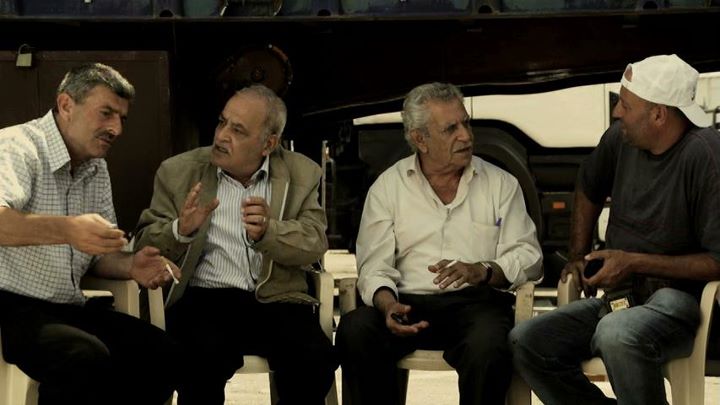
The story is human. And through these humans, we see the past. As it was. Unedited memories of what real life used to be. No voice over. No script. No interview. Just regular, ordinary chats. 

Photo: Gate #5

These men talk to each other, or the filmmaker, casually. Simply. As if no camera was there. As if they were having one of their daily informal discussions over coffee. Because this is what these men do every day. They remember. They talk. They reminisce about their golden years. That day, they just happened to be recorded while doing so. 

We know these men. Not them particularly, but others just like them. That is how we know these moments in the film are genuine. That is how we know this movie speaks a truth. Maybe not the Truth. Maybe some even take pleasure in storytelling and embellishing a little. Just like those other men we know and we have listened to before. At our family dinners. In a cab. At an old coffee shop.  

And that is why this film speaks to us. At a personal level.

By the end, I could not help but lean towards my husband and whisper: "you know next time we're in Beirut and you have one of your drinks with your dad, just take the camera and record". He is always saying something. They all are. 

And the fact that Gate #5 inspired us to actually pick up a camera and listen is the plain proof that this film works. That it achieved its purpose. That it created something, beyond that theater, even after those end credits rolled on that big screen. That it touched real people. And that it affected real life. 

Q and A with Simon El Habre following the screening
Photo: R. Abouzeid


Useful references and sites:


Find this blog on Facebook

Thursday, November 10, 2011

Now we go ... to the movies

English


As you already know we've managed to squeeze an evening at the movies when hubby was here. I'm not going to get into the whole "Parents Vs. Movies" debate. It's a loosing battle. The purpose of this post is not to rant anyway (thank God!) but rather share one interesting and moving evening with all of you.

I couldn't ignore the nominations, awards and praises bestowed upon this piece and the artist behind it, which all speak for themselves, and loud enough might I add and which left me with the highest of expectations. 

To be honest I refrained from reading anything because I intended to experience the film with a fresh eye. And I'll grant you that same courtesy, don't worry. Which means I won't bore you with my critique of the movie. There's a plethora of very pertinent (I'm sure) reviews out there on the net. 

So why even write this post, you may ask?

Well first of all, to tell those two or three people who haven't yet watched "Where Do We Go Now?" to make the time. For a very simple reason: it is a simple, beautiful, sensual and genuine poem on Lebanon. 

If this film were a woman, it would be Nadine Labaki, simply. And just as a quick reminder for those who may not know or have forgotten, here's what the woman looks like. Convinced yet?

If not, let me just add the following...

"Where Do We Go Now?" tackles issues that are still relevant to our people, our nation and probably the entire Arab world today more than ever. 

But it is also and above all an ode to Humanity. Mankind. 

And probably the most flattering compliment to religions and faith. The true value and intent of religions and faith: Love. 

Nadine Labaki makes a commendable effort to shed light on human relationships, how easily ignorance and fear can turn the kindest and the closest of human beings into mortal enemies and most importantly how when we focus on the truth and tolerance, life wins. Because there is no escaping death. So the lesson undeniably remains life, the great measure it takes when faced with the end, and by extension, what we should do with it.

As with "Caramel", the cinematography is wonderful. Beauty is everywhere even in the simplest, poorest or sickest of places. Even in death. And the music, which becomes a character in its own right, is absolutely perfect. The poetry it brings is so intrinsic to the characters, the places and the story that it doesn't feel like an artistic addition. It is simply a part of life. A natural element of reality.

Everyone should take a glance at that reality. At beauty. And at love.

The promise was kept: I laughed. I cried. And days later, I find myself still immersed in that universe which is really only an innocent wish for a better world. The desire. The hope. The humble prayer of a people who have nothing else to lose and everything to win.


Your Bookmarks:


Find this blog on Facebook
And Share:
Share to FacebookShare to TwitterShare to MySpaceMore...More 

Thursday, June 9, 2011

D like Dubai

English

50% of my time on the phone is spent spelling!
I find myself singing the phonetic alphabet at almost every call:
  D like Dubai
       I like India
C like Charlie
         K like Kangaroo
    E like Echo
  N like November
      S like Sugar
Yeah, I know, I'm making some of them up but that's really not why I'm writing this post. Today a couple of things happened that prompted me to pour my heart out on Facebook:

I have absolutely no problem if people can't speak Arabic or English in Dubai. I take issue with companies that put them on the phone with customers! Why torture both your clients and your hardest working employees? I say hardest because these people are drivers and delivery men. Let them DRIVE and DELIVER! It's hard enough in this weather! Have an admin, someone who can speak both English AND Arabic make the calls!
Someone just called to take down my address and deliver a package. Try spelling Dickens Circus over the phone when there's no common language to communicate!
(Oh! AND an Arab who's not proficient in English should be able to get services in Arabic in an Arab country!)
Source

My building's named after Charles Dickens, and as beautiful as that may be, every time I have to verbally give my address to someone, it never fails: no one understands a word! And don't think that mentioning "Dickens, as in Charles Dickens, you know, the author" would make any difference.

Well, it probably doesn't help that I live in Motor City and that for some unrelated reason, buildings and streets are named after renowned writers. Ferrari Street would have been easier to explain: "Yes, like the car, Ferrari; I live in Motor City! Duh!".

Instead we're stuck with literature!

In this day and age, it would have been really more practical to name the streets Google, Facebook, Twitter and YouTube. But no, the creative people at Union Properties preferred authors.

And why make it easy when you can make it even harder: the buildings are either clustered in "Circuses" when they form a complete circle, or "Crescents" when they form half a circle.

That makes me a resident of Dickens Circus.
Seriously.

I'm only kidding about the names of our buildings; I do like them.
Our community is really beautiful and I love living here.

But obviously it would have been easier to live on Shakespeare Circus. Everyone knows Shakespeare (or at least his name) and somehow I'm sure I could have convinced the whole world that in my building, all residents are dedicated to putting Shakespeare's plays on stage, in a Circus tent, because we can't afford a real theater.

My flat-mate Charlie (Dick for close friends) was so right when he wrote:
"It was the best of times, it was the worst of times"
The best is at Motor City.
The worst is telling people how to get to The Best without getting lost! It's a little like Atlantis; the island, not the hotel. Everyone knows it's there, but no one is really sure how to reach it.

OK, it's not that bad and I only kid for the purpose of entertaining my wonderful, loyal, one and only reader. Somehow I know you are out there. I know you read my posts. I know you wait for new ones. And I am a little scared you may start stalking me one day. But not too scared. Just the right amount that Hollywood celebrities feel on a daily basis when they pass by Starbucks for their morning caffeine shot.
Dear Future Stalker, kindly disregard the following paragraph. Thank you
And if you plan on moving to Motor City but are too worried you'll be stranded like Tom Hanks and Wilson, don't worry, you can always choose to live in Bennett House, Norton Court, Widcombe House, Sherlock House, Fox Hill or the Terrace Apartments. Somehow they're easier to understand than "Circus".

Oh, and let me reassure you dear reader, yes, I did receive my package this morning. Thank you for asking. 

But seriously, I wasn't kidding about the pre-delivery call. It's really frustrating when all the while someone who's proficient in English could have taken all the details and given clear directions to the driver.

I personally talk London very best and eventually, I managed to agree on the basics with that delivery man (who was so nice by the way). But what if my mom had gotten that call? Yes, she does pass by Dubai from time to time. Or any other non-English speaking poor soul? 

Dubai is such a cosmopolitan hub that sometimes you forget you live in an Arab country. But it is exactly that: an Arab country.  

Once hubby was at a main Supermarket chain in one of Dubai's largest shopping malls and he saw an elderly Emirati man, probably in his 70's, fighting with a cashier from the Philippines. She couldn't understand a word he was saying and since he wasn't proficient in English, he couldn't understand what she was saying either.

He was appalled that in his own country, he could not find one person able to provide him with answers in his mother tongue.

He was right.

I am not saying that we should get rid of all the non-Arabic speakers in town, far from it!

But at least, in common places where customer service is essential (if not the only thing staff does) and customer means all and any human being, employees should be able to speak primarily the country's native tongue, in addition to English to cater to non-Arab customers who obviously are a large market in Dubai.

A humble opinion.

(In case you're curious, here's the other incident I reported on Facebook)

Thursday, March 31, 2011

On inspiration, deception, depression and all the "sions"

English

DEPRESSION : INSPIRATION
FRUSTRATION

Fear not dear, loyal reader (if there's anyone out there!) I am not really depressing. It's just that a lot around me calls for a great deal of sadness these days.

Mia aside that is, of course. She's probably the one thing that's keeping me from officially being  institutionalized.

2010 has been a bitch!

Naturally, I forgave her because she ended up giving me Mia just one month before she finally hit the road. But I just couldn't wait for 2011 to finally come. We all needed a break. Well...

2011 doesn't look any kinder

Which sucks, royally. Because I will need some good stuff to keep my sanity and chocolate won't do it anymore. Of course I still have Mia's cheeks but I don't want to be that annoying mother that keeps following her child and steals a few kisses by force. Because eventually, she'll get bored of my overbearing affection. Then what?

Hubby cannot reiterate it enough: I am a Drama-Queen.
Capital D, capital Q.
Capital DRAMA actually.
And I won't argue much with that theory because well, let's be honest, I do have my dramatic moments. Every day.

But these past months would have been unbearable for just about anyone in my shoes.
Or crocs, they're all that fits right now.

Too many people left us, way too soon

First there was a close friend's cousin. He was in his forties, in good health. To add even more cruelty to the tragedy, it ironically happened on his way back from jogging. He was in his living-room with his family when his 5 year old daughter asks him to read her a story. He gently declines telling her he is tired and lays down on the couch. Suddenly he tells his wife he's not feeling OK and has a stroke right there, in front of his wife, his daughter and his baby boy! I didn't know the man personally but we had many common friends. Clearly, the 995 people who joined the Facebook group created in his memory can only attest how appreciated he was.

It was disgusting.
He was young.
Healthy.
He exercised.
He wasn't that much older than us.
And he was leading the same kind of life we do.

The lifestyle similarities, the common friends, his age...
Everything was disturbing.
Unfair.
Tragic.
Utterly disgusting.

Ironically, he had been supporting a common friend who had lost her mother a few days earlier. Her mom had been sick for years and couldn't get out of bed anymore. And yet, it still felt as unfair as ever. She was my friend's only family. She raised her on her own. A real-life hero. And as if being horribly sick and in pain for years wasn't enough, she was robbed of the joy of  seeing her only child get married. She will never kiss her grand-children. And they will never have the privilege of meeting her.

Life's cruel ways

A few months later, it was another friend's turn to leave us suddenly. He was only 30, we attended high-school together. He was so friendly and socially and politically active that he became one of those popular guys that everyone loves in college. Three groups were created in his memory on Facebook. One has 2,366 members, the others 255 and 361. Obviously, "popular" is an understatement. He was riding his bike on one of the perfectly-maintained and super-safe highways in Lebanon when he crashed in a pit.  A freaking pit in the middle of the highway! Just like that.

It hit hard.
He was too young. Obviously.
And his accident was outrageously ridiculous and absurd.

Horrific.
Hideous.
Disgusting.

Then came Ziad
Dear Ziad

Also in his forties, also with a young family; a three-year old baby girl. And also in the most unfair and dreadful of ways: Cancer. Ziad was the closest. He was family. We went to the doctors' appointments with him. We followed up his treatment. We supported him and his wife throughout the most hideous of ordeals. And he simply left. Just like that. Leaving everyone and everything behind. He had only begun to build a good life for himself and his family. He was finally happy at his job. At last he was close to home. He was close to his loved ones. He was close to us. And only a few months after we celebrated all these accomplishments which everyone had prayed for for so long; he is diagnosed with advanced Cancer. He struggled like a hero for months before his body finally gave up. His soul was never weakened. His heart was saddened, yes; but his soul remained intact. How can anyone justify that to his daughter? What do you say? Life sucks, deal with it?

Do I really have to say it?
Disgusting.
There. Said.

Surreal and brutal

Only a few weeks after he visited me at the hospital to meet Mia for the first time and congratulate us, one of the sweetest and most innocent man I know was brutally attacked and murdered in his own home. He too was in his forties. He too was healthy. He too was young, bright, kind. He too was loved by so many people. And he too left in such a hideous and terrifying way. Murdered. I thought I would only know that word through movies and books. Maybe the evening news. It turned out my friend made the evening news this time.

The horror

Just a few days later, my dad goes to check on his best friend of 30 years. He finds him in his home, sleeping peacefully on his bed. Gone. Just like that. No warning. No reason. He was a bit older than the friends I mentioned above, granted. But 60 is still too young and too ridiculous. People don't just die for no reason. At 60. Not in this day and age. He was an artist; a filmmaker and a photographer. He was an activist always ready to tackle the most sensitive issues. He passed away before he could witness the Arab revolutions. He would have loved them. He would have been part of them. He, who made documentaries on the Israeli war on Lebanon; on Iraq; on Egypt's Abdel Nasser. He was supposed to be there. He was supposed to see and experience the pride of those he supported for so long. He was supposed to film the revolutions he's always encouraged. Was supposed to. Didn't. Never will again. Just like that. Ironically, because apparently life is too cruel not to be filled with disgusting irony, he was the healthiest man I know. Always giving advices on how to eat, how to exercise, what to do to live a long, healthy life.

Disgusting?
It was much more than that to all of us at home.
My dad hasn't recovered yet.

Fate did not spare him anyway.

What the hell?!

A few weeks after he buried his best friend, the one he spent each and every day with; my dad lost his mother. On his birthday. The irony never stops, right? This date that will now be stained forever in his eyes. Yes, she was senile. Yes she was sick. And yes, she was 90 years old. But it still felt like a knife in the back. Forty days later we lost my grand-father. Forty days. Forty damn days. We consoled each other: they had lived a full life, together, up until the end. They had been happy. They got sick together (Alzheimer). And somehow, I don't know how, they left together. As it should be. Is it less disgusting?

Make it stop!

Now, a few days ago another friend my age, in his early thirties, left us. A day after his birthday. Didn't I mention life was too cruel not to be ironic? I hadn't seen or spoken to him in years. Then I see his name on my Facebook calendar, so I wish him a happy birthday and he replies that same day. We exchange a few messages and I wait for him to let me know when he'll be visiting Lebanon (he lives in Washington) so we can get together. The reply never came. He passed away that day, probably before he could even read my message. He was not one of those people who dismiss others. He was one of the kindest souls I know. Truly. absolutely not one person who knew him disliked, let alone hated him. Not one. And now every time they will remember his birthday, they will remember his departure.
Absurd.
Cruel.
Ironic.
Disgusting.

WHAT THE HELL LIFE?
WHAT THE HELL IS WRONG?
SO WRONG.
NOTHING SEEMS FAIR.
NOTHING SEEMS TO MAKE SENSE.
WHAT THE HELL?!